
The Gut-Skin Connection: Why Your Toddler's Eczema and Constipation May Be Linked
If your toddler has eczema and struggles with constipation, you've probably had this thought more than once: These have to be connected somehow… right?
Maybe you've tried the steroid cream(s). Prune pouches. Miralax. Cut dairy for a month because someone on Reddit swore it worked. Your pediatrician keeps saying they'll grow out of it, but something in your gut tells you there's more to the story.
There’s a connection here: let’s walk through how the gut + skin are related.
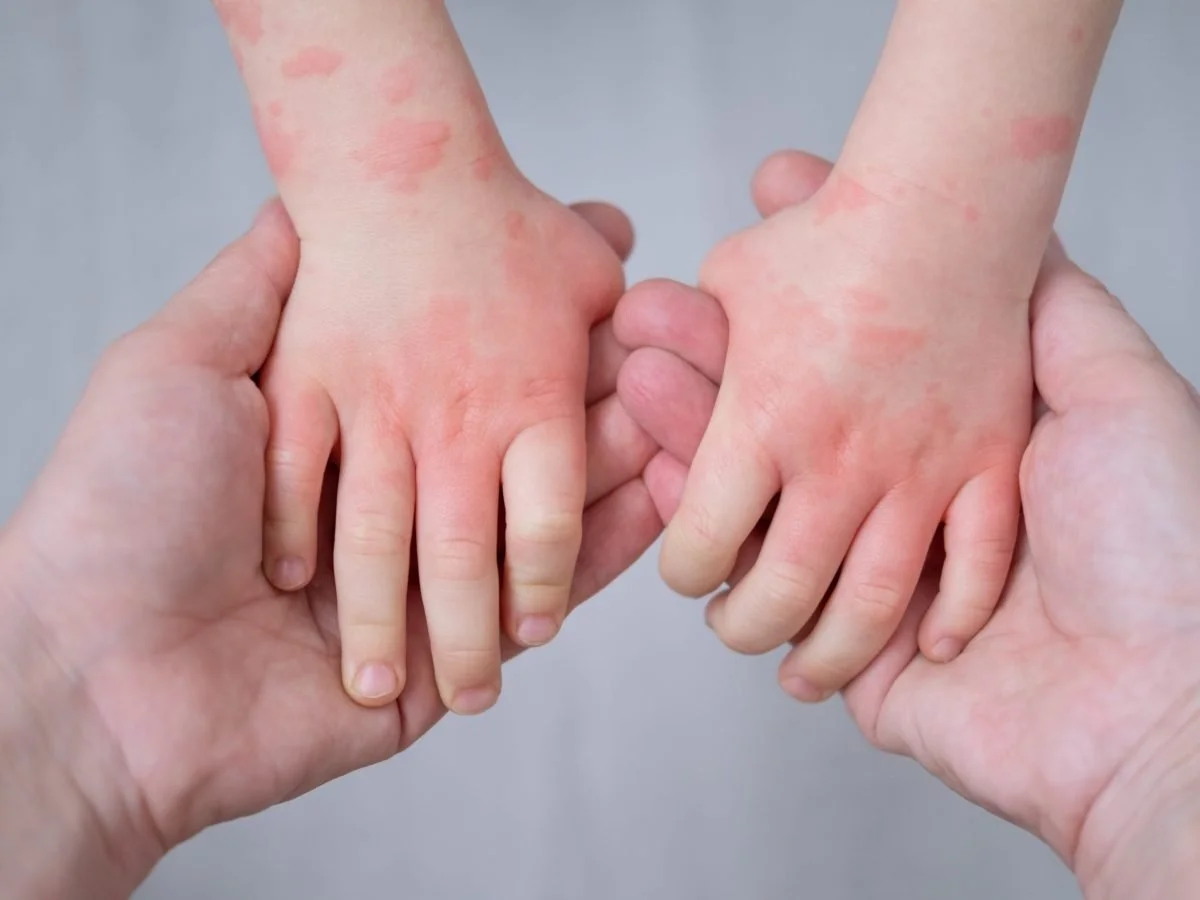
The gut and skin are constantly talking to each other
Here's what most people don't realize: your child's gut and skin aren't working in isolation.
They're both barrier systems. They're both shaped by the immune system. And they both depend on a healthy gut microbiome to do their jobs well.
You've heard of the gut-brain axis? Well, there's also something called the gut–skin axis: a two-way communication highway where inflammation, immune signals, and bacterial byproducts travel between the digestive tract and the skin. Research consistently shows that changes in gut health can influence inflammatory skin conditions like eczema.
The gut doesn't just digest food. It's constantly sending signals throughout the body—to the brain (affecting mood and sleep), to the immune system (influencing inflammation), and to the skin (impacting everything from eczema to acne). When gut health is off-balance, those signals can show up in unexpected places. That's why a child with constipation might also struggle with sleep, irritability, or skin flares that seem to come out of nowhere.
In toddlers, these systems are still under construction. So when something's off in one place, it often shows up somewhere else.
That's why skin issues and digestive struggles tend to travel together.
Eczema isn't just a skin thing
Eczema (a type of atopic dermatitis) isn't happening because your kid's skin is dry. It's driven by immune dysfunction—specifically, the pathways involved in allergic inflammation. And those immune signals don't just stay on the surface. They circulate through the whole body.
In the gut, that same inflammation can:
Slow down how quickly things move through the intestines
Make the gut more sensitive
Turn bowel movements into something your child wants to avoid
Over time, this can lead to stool withholding and chronic constipation.
I'm not saying eczema causes constipation. I'm saying the same underlying immune and nervous system wiring can set the stage for both.
The microbiome is the missing link
One of the biggest pieces connecting the dots? The gut microbiome.
Kids with eczema tend to have less microbial diversity and fewer beneficial bacteria—like Bifidobacteria and Lactobacillus. The same pattern shows up in kids with chronic constipation.
Why does this matter?
Because gut bacteria produce short-chain fatty acids (SCFAs), which help:
Keep stool moving at the right pace and consistency
Protect the gut lining
Calm down the immune activity that fuels skin inflammation
When the microbial balance is off, both digestion and skin regulation can struggle.
Minerals matter more than you might think
Certain minerals also play a surprisingly important role in both skin and gut health.
Zinc is critical for skin barrier integrity and immune function—and research shows kids with eczema often have lower zinc levels than healthy children.
Magnesium acts as a natural osmotic laxative, drawing water into the intestines to soften stool and relax intestinal muscles, which is why it's often used to treat constipation.
Iron deficiency is also more common in children with eczema, potentially due to how chronic inflammation affects iron absorption and immune function.
When these minerals are low, the gut and skin can both struggle to regulate properly—showing up as ongoing constipation, reactive skin, or both.
For kids who are picky eaters or have feeding difficulties, getting enough of these minerals through food alone can be genuinely challenging. Limited variety, food avoidance, or past elimination diets can all make it harder to meet mineral needs consistently, which is one reason why working with someone who understands both nutrition and feeding matters.
Diet changes help... until they don't
A lot of toddlers with eczema are also picky eaters.
Some avoid certain textures. Some live on pasta, crackers, and yogurt. Some have been on elimination diets after a flare or reaction—even if just for a little while.
These changes make sense. You're trying to help. But over time, a limited diet can affect:
Fiber variety and intake
Hydration
Gut bacteria balance
Overall nutrition
Research shows that elimination diets in kids with eczema can increase nutritional risk if they're not monitored carefully. Not because parents are doing anything wrong—but because feeding, digestion, and immunity are all tangled up together.
Stress and discomfort feed the cycle
Eczema is itchy. It disrupts sleep. It's uncomfortable.
Chronic discomfort raises stress hormones, which directly mess with gut motility through the gut–brain axis. Add one painful poop, and many toddlers start holding it in—clenching, avoiding the urge, making the constipation worse.
If you're exhausted from tracking bowel movements, skin flares, sleep patterns, and food intake in your notes app... and you still feel like no one's connecting the dots?
This is a really common pattern. And it deserves someone who looks at the whole child—not just one symptom at a time.
What actually helps (without the overwhelm)
When eczema and constipation show up together, progress usually comes from zooming out and looking at the full picture… not just chasing symptoms one by one.
That might include:
A stool test to understand your child's gut function + microbiome health
Evaluating the type of fiber they're getting, not just the amount
Supporting hydration, healthy fats, and key nutrients
Reducing mealtime stress while protecting growth
Not all at once. Not perfectly. And definitely not through force or food battles.
The goal isn't to "fix" your child. It's to give their body the support it needs to do what it's already trying to do.
When it's time to get extra support
If you're noticing:
Constipation that won't budge despite trying all the usual strategies
Eczema flares that seem tied to limited eating
Growing food restriction or anxiety around meals
A pediatrician who's reassuring... but it doesn't quite match what you're seeing at home
It might be time to bring someone in who can look at how nutrition, digestion, and feeding fit together—not just in isolation.
A lot of families feel relief when nutrition support works alongside feeding therapy and medical care. It helps translate what you're seeing into a clear, personalized plan.
The bottom line
If your toddler's eczema and constipation feel connected, trust that instinct.
The gut, skin, immune system, and nervous system are in constant conversation. In young kids, that conversation can show up in more than one place at once.
You don't have to keep playing detective by yourself. And you don't have to choose between supporting nutrition, digestion, or feeding.
With the right support, those pieces can finally come together.
Ready to stop piecing this together alone? Let's create a plan that actually fits your child and your family. Book our first visit today!
References
Salem, I. et al. (2018). The gut microbiome as a major regulator of the gut–skin axis. Frontiers in Microbiology.
Werfel, T. et al. (2016). Cellular and molecular immunologic mechanisms in atopic dermatitis. Journal of Allergy and Clinical Immunology.
Vriesman, M. H. et al. (2020). Pathophysiology of functional constipation in children. Neurogastroenterology & Motility.
Penders, J. et al. (2007). Gut microbiota composition and development of atopic manifestations in infancy: the KOALA Birth Cohort Study. Gut.
Zoppi, G. et al. (1998). Intestinal microflora in children with chronic constipation. Journal of Pediatric Gastroenterology and Nutrition.
Trompette, A. et al. (2014). Gut microbiota metabolism of dietary fiber influences allergic airway disease. Nature Medicine.
David, T. J. et al. (1984). Nutritional hazards of elimination diets in children with atopic eczema. Archives of Disease in Childhood.
Mugie, S. M. et al. (2011). Constipation in childhood. The Lancet Gastroenterology & Hepatology.
Gray, N. A. et al. (2019). Zinc and atopic dermatitis: a systematic review and meta-analysis. Journal of the European Academy of Dermatology and Venereology.
Loening-Baucke, V. et al. (2011). Serum magnesium concentration in children with functional constipation treated with magnesium oxide. World Journal of Gastroenterology.
Drury, K. E. et al. (2016). Association between atopic disease and anemia in US children. JAMA Pediatrics.
