
New Dietary Guidelines Are Here… What Do They Mean for Real Kids?
In case you've been away from the news this week... the new 2025-2030 Dietary Guidelines just dropped.
Everyone has an opinion, but there's been surprisingly little discussion about what they actually mean for kids.
I read them through the lens of the parents I work with every day - the ones worrying about picky eating, feeding difficulties, kids struggling with growth, constipation, poor sleep, brain fog... all of it.
So when new guidelines come out, I don't ask "Is this technically correct?"
I ask: will families like the ones I work with actually see themselves here?
There are parts of these guidelines that genuinely made me excited. And there are parts that made me pause… not because they’re incorrect, but because I don’t see many of the kids I work with reflected here.
The Good Parts
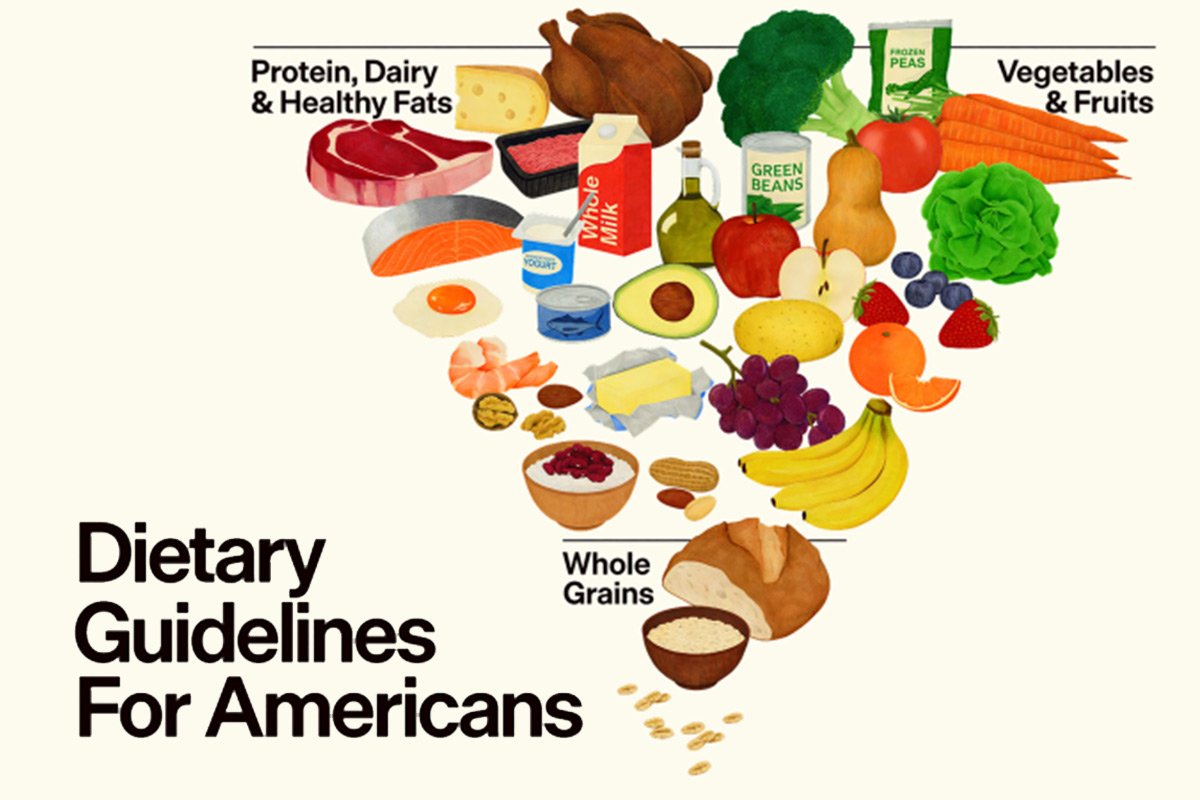
I appreciated the clear emphasis on real food and moving away from highly processed foods as the foundation of the diet.
Protein is prioritized from both animal and plant sources, which matters for growing bodies. It supports muscle, bone, and tissue growth, plus the enzymes and hormones involved in digestion, metabolism, and sleep - really, every facet of development.
Ideally, protein is offered at each meal… even if kids aren’t eating it yet and it’s simply there for exposure (yes, that still counts).
Getting enough can be challenging for many of the kids I work with, but there are lots of creative ways to support intake that don't rely on just eating more meat - especially when there are feeding challenges.
Fruits and vegetables are also emphasized, which is a great balance to the focus on protein. We need protein for many reasons, but gut health relies on fiber and phytonutrients too.
Dairy is also included, specifically full-fat dairy. This isn't new; dairy has been a part of the DGs for decades.
Healthy fats, specifically olive oil, avocado, seafood, full-fat dairy, butter, and even tallow are highlighted. That's a new one! I would have loved to see coconut oil mentioned as well - but alas. I do recommend varying fats & oils because they have different nutrient compositions.
Whole grains are higher in fiber than refined/simple carbohydrates, which are recommended in smaller portions.
Lastly, the recommendation is to limit ultraprocessed foods like chips, cookies, candy, drinks with artificial flavors/preservatives, and non-nutritive sweeteners.
In the adult section, added sugar is recommended to no more than 10g per meal. This does NOT include naturally occurring sugar from foods like fruit.
Despite all of the hate on social media - none of this feels radical. It feels like what many of us know to be the foundation for health.
Starting Solids (a part I really loved)
One of the stronger sections, in my opinion, is the language around starting solids.
Instead of fixating on age, the guidelines focus on developmental readiness — things like sitting with support, head and neck control, bringing hands to mouth, opening when food is offered, actually swallowing instead of pushing food out.
That’s responsive feeding. That’s what feeding therapists have been saying for years! And it reinforces something I wish parents heard earlier and more often… your child will eat when they’re ready.
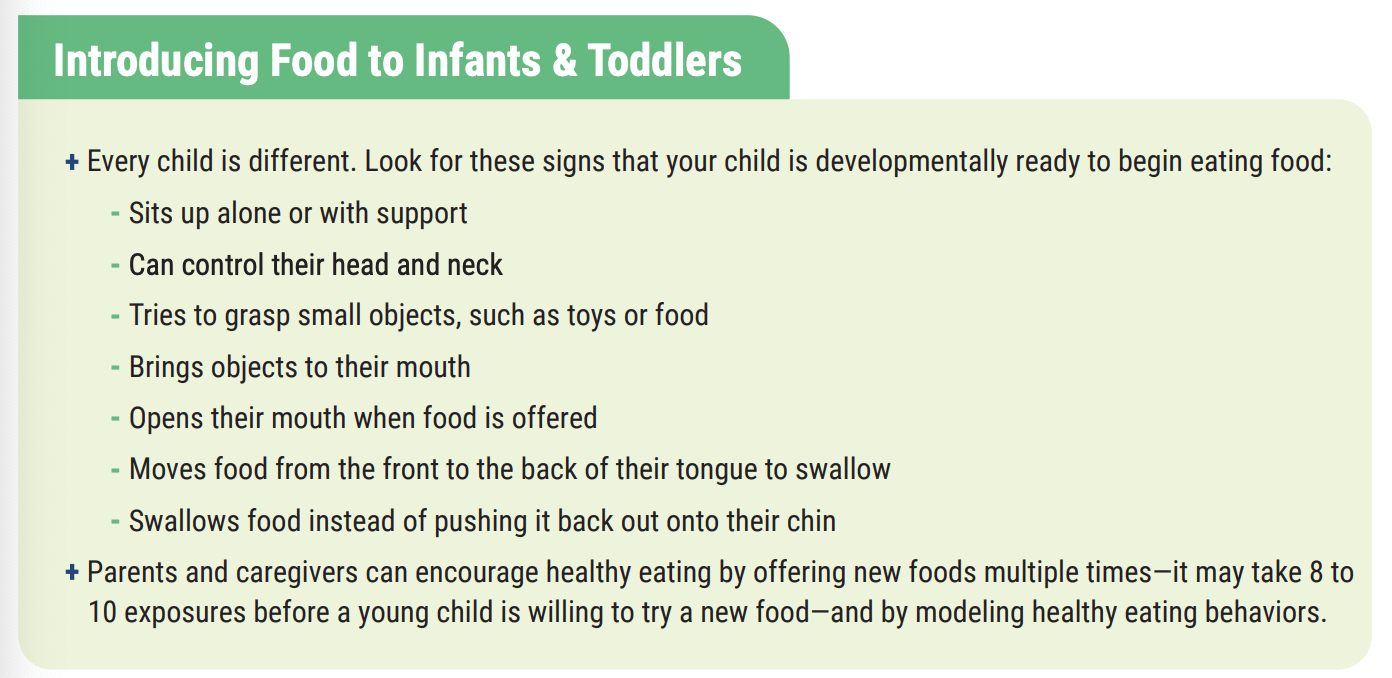
They also name something that’s incredibly validating for parents of selective eaters… it can take 8–10 exposures before a child is willing to try a new food, and modeling matters more than pressure.
This was literally the most exciting part of the entire DGs for me!
I've actually seen research that supports some kids may need 15-50 exposures (and even up to 50 exposures for neurodivergent kids) - but the fact that repetition & exposures are being discussed at a national level is huge.
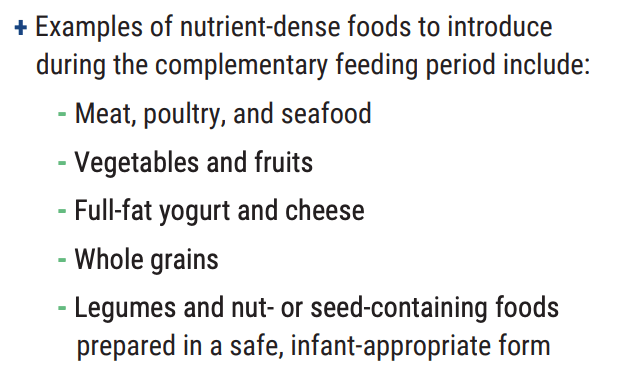
They also emphasize that infants should be offered a diverse range of nutrient-dense foods in textures that are appropriate for their development, while avoiding nutrient-poor, highly processed foods.
And I really appreciated that this wasn’t framed as “you must do baby-led weaning” or “you must do purées.”
It’s not about the method. It’s about their skill and stage of development.
The right texture for your child. Based on their skills, and at their pace.
For some babies, that looks like soft finger foods early on. For others, it’s purées that slowly evolve. Both can support development when they’re responsive, varied, and pressure-free.
The part that made me pause
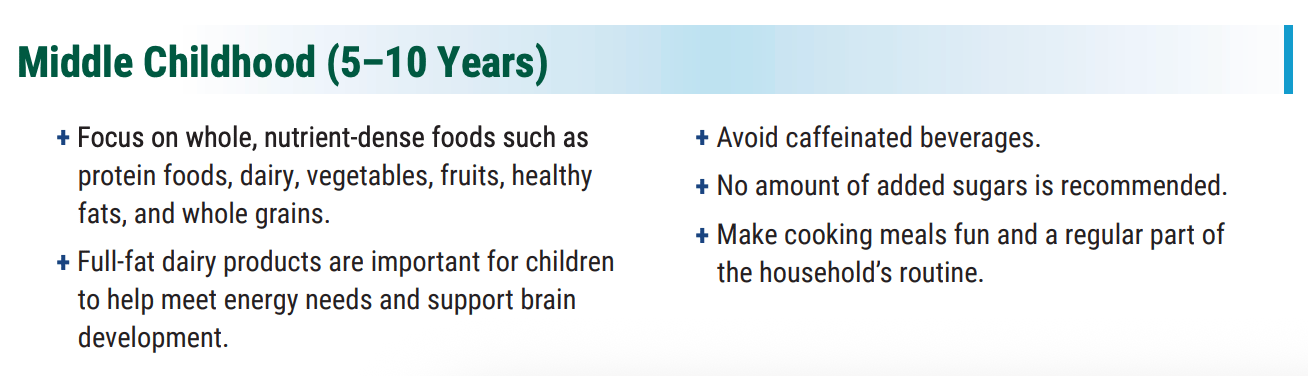
There’s a line for ages 5-10 year olds that says “no amount of added sugars is recommended.”
The statement is biologically correct, but in my opinion, clinically unhelpful.
From a purely technical standpoint, sure - sugar isn’t beneficial for health, at any age.
But sugar isn't going anywhere.
It's a part of our food system, culture, schools, holidays, traditions, and celebrations. Birthday cake. Classroom treats. Sports snacks. That’s part of childhood.
And by ages 5–10, kids are old enough that parents no longer have full control over every bite they eat. They’re eating at school, at friends’ houses, at practices and birthday parties.
We needed a number to shoot for.
Without that, “no amount is recommended” turns into “this should be avoided at all costs.”
This part is important: we don’t reduce harm by pretending it’s avoidable.
When foods become forbidden, it can increase fixation or risk for disordered eating.
For kids who are already selective or anxious around food, rigid rules tend to backfire.
We needed better data, research, and guidelines around this, not a blanket "no".
A note on gut health
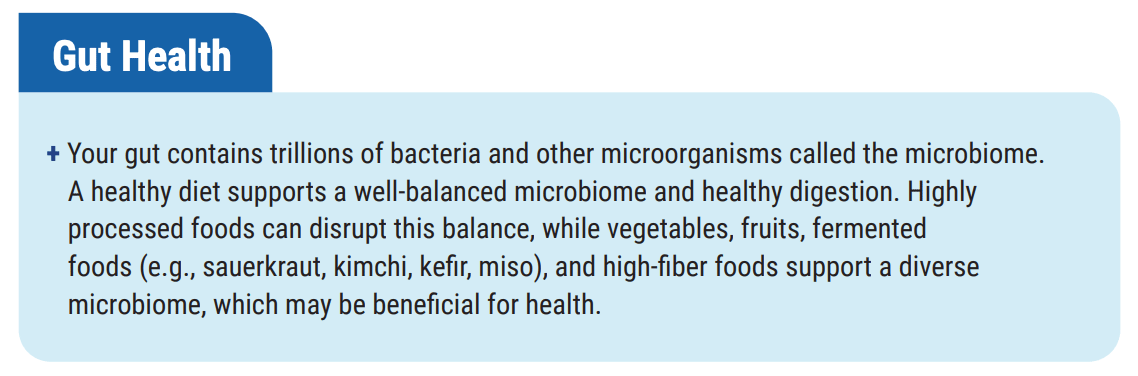
I was so excited to see gut health acknowledged, even though it lives outside the pediatric section.
For the first time, the guidelines explicitly acknowledge that the gut microbiome plays a central role in overall health... not just digestion.
The gut isn’t just about stooling/constipation etc (even though that’s often where parents first notice something’s off).
The gut is deeply connected to the brain, the immune system, sleep, mood, appetite regulation, and more.
This is the gut–brain axis: a two-way communication system that helps explain why constipation, poor sleep, picky eating, anxiety, skin issues, and even attention challenges often show up together.
Supporting the microbiome isn't just trendy, it really is key to overall health - for both adults & kids alike. Seeing that acknowledged at a national level is really exciting.
The bigger picture
One thing that’s worth noting… the previous 2020-2025 Dietary Guidelines were dense. Over 160 pages of graphs, data, and context.
This version is a 10-page summary, backed by a much longer scientific report that most families will never read.
That means nuance gets lost. And nuance matters a lot when we’re talking about kids, development, and feeding relationships.
That also means parents (& nutrition professionals too!) get soundbites without the supporting research that explains exceptions and flexibility.
Guidelines can be helpful… but they don’t replace flexibility and real-life context.
Overall
I know there's nuance here. There's work to do to make healthy foods more accessible throughout the US, and work to ensure kids have the skill and ability to consume these foods.
But I genuinely think these guidelines provide a solid framework: more protein, more fiber, nutrient-dense whole foods, less ultra-processed options. These are good priorities to work toward.
For the families I work with who are dealing with picky eating, feeding difficulties, or kids struggling with growth, the challenge isn't knowing what their child needs to eat.
Most parents already know their kid needs more protein and vegetables.
The hard part is the how. How do we actually get kids to eat these foods? How do we support progress without creating more stress, pressure, or food anxiety?
That's where working with a pediatric dietitian or feeding specialist comes in - we can bridge the gap between what guidelines recommend and what's actually achievable for your child, at their pace.
